“A vicious circle of incompatibility”
A fun 16-minute video from PortalRunner with this premise:
This is an image file, containing a picture of my cat. But if I rename it to .MP4, it becomes a video file – also of my cat. If rename to .PDF, it becomes a text document containing the script for this video. It can also be a valid webpage, a .ZIP archive, or a PowerPoint presentation, all by simply changing the name. This kind of file is sometimes called a “polyglot” (although, usually that term refers to code that works in multiple programming languages).
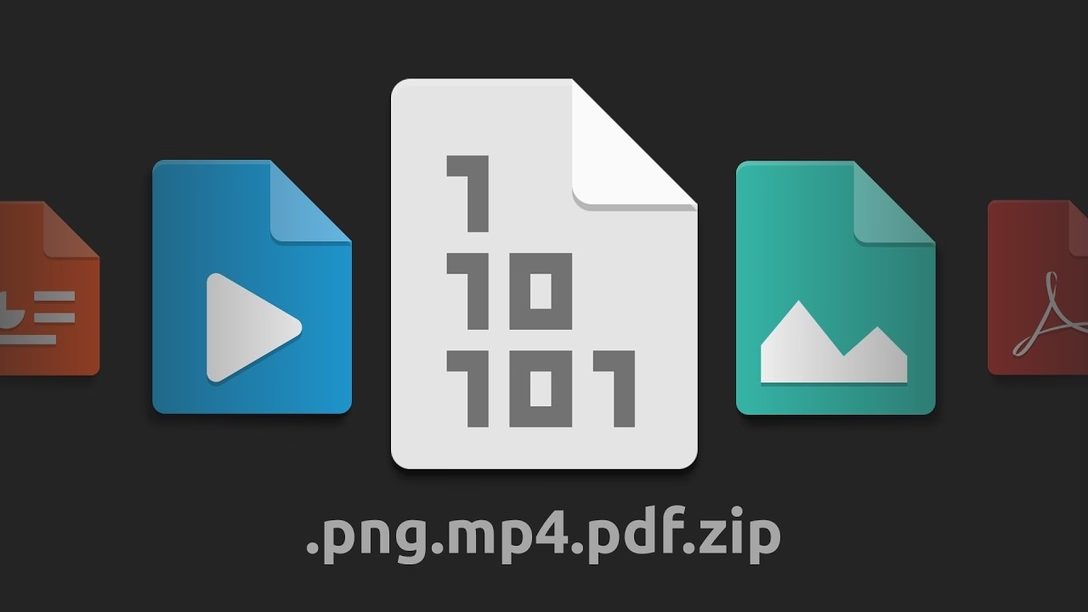
This kind of a file is not something that you will realistically need, but it’s a fun look into various approaches to headers and structures of file formats – something we don’t usually get to think about a lot.
Buried inside the video is also an interesting digression: is the file extension just a method of delivering the file to the right application? If I rename .jpeg to .gif, and both are routed to Pixelmator, should Pixelmator do its best to detect it’s a JPEG file under the hood, or fail with a “this doesn’t look like a GIF file” message?
The web has a similar challenge in the form of MIME sniffing – “MIME” is sort of the web’s equivalent of extensions, “sniffing” means detecting the file from its contents alone, ignoring everything else – and that had some security considerations, as it allowed bad actors to sneak in some malicious code under the guise of something more innocuous… basically what the video is doing for fun, but now weaponized.
This is all pretty technical for this blog, but inside the Wikipedia entry for MIME sniffing is this passage that caught my attention:
[MIME sniffing is still used by some browsers. However,] by making sites which do not correctly assign MIME types to content appear to work correctly in those browsers, it fails to encourage the correct labeling of material, which in turn makes content sniffing necessary for these sites to work, creating a vicious circle of incompatibility with web standards and security best practices.
Decades before MIME sniffing, Jon Postel captured the essence of that line of thinking by coining Postel’s Law – “be conservative in what you send, be liberal in what you accept” – but as enticing as it is, that has challenges similar to the above quote:
A flaw can become entrenched as a de facto standard. Any implementation of the protocol is required to replicate the aberrant behavior, or it is not interoperable. […] Ensuring interoperability in this environment is often referred to as aiming to be ”bug-for-bug compatible”.
While Postel’s Law was about data flowing in and out of computer systems, the premise is to me a more evergreen design question, applicable to so many other things. Feeling “liberal in what you accept” can feel helpful, but can teach users bad habits and have bigger consequences. For any project where this applies, it’s worth asking: should we go out of our way to help the user even if they mess up, or should we be more rigid and teach them to follow the rules more strictly, as it will benefit them in the future?
The Command Line Interface Guidelines I linked to before had a great example of that:
You can ask if they want to run the suggested command, but don’t force it on them. For example:
$ heroku pss

› Warning: pss is not a heroku command.

Did you mean ps? [y/n]:
Rather than suggesting the corrected syntax, you might be tempted to just run it for them, as if they’d typed it right in the first place. Sometimes this is the right thing to do, but not always.Firstly, invalid input doesn’t necessarily imply a simple typo—it can often mean the user has made a logical mistake, or misused a shell variable. Assuming what they meant can be dangerous, especially if the resulting action modifies state.
Secondly, be aware that if you change what the user typed, they won’t learn the correct syntax. In effect, you’re ruling that the way they typed it is valid and correct, and you’re committing to supporting that indefinitely. Be intentional in making that decision, and document both syntaxes.