“Approximately 21 times the estimated age of the universe”
A few years ago, some sort of a bug at my work caused all of the timestamps appear as “54 years ago,” a seemingly arbitrary date. It took me a bit to realize: “Wait, you know what year was 54 years ago? 1970!” “Why is 1970 important?” asked another designer. I explained that by convention, Linux time counts up from Jan 1, 1970 – and so if the time “value” is zero or unavailable, as it was because of the bug, it would be rendered not as an error, but as that specific day long ago.
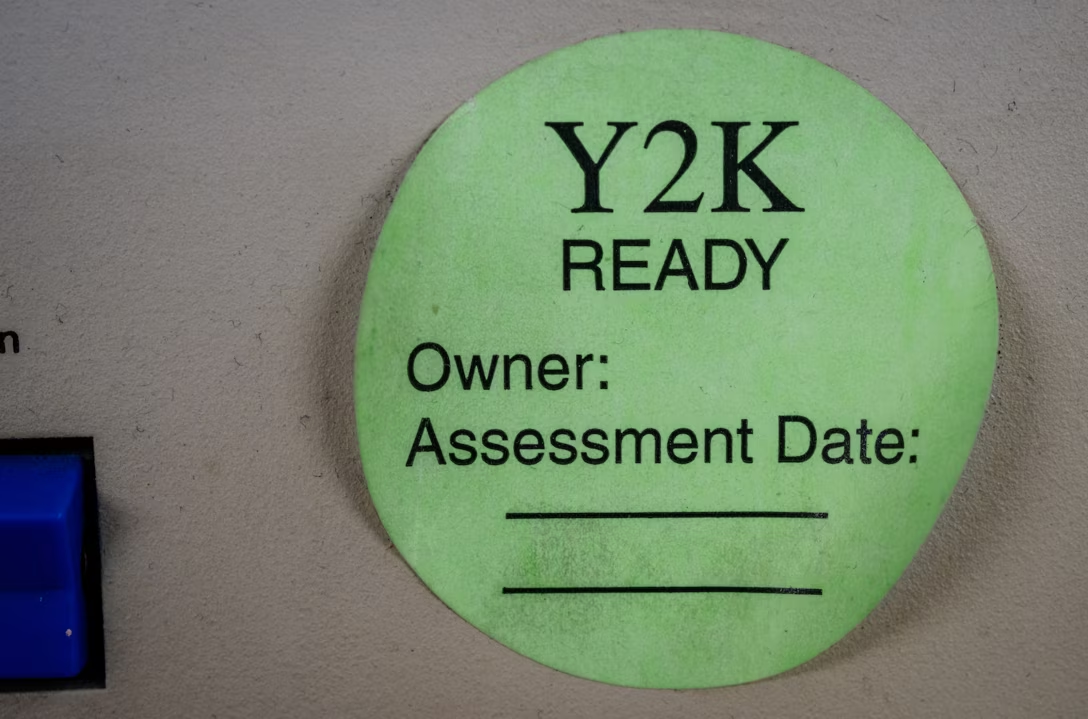
Computing is filled with all sorts of arbitrary numbers like these. The most famous one was Y2K (99 + 1 = 00 if you only allocate two digits), Pac-Man’s kill screen was number 256, people still bring up the infamous and likely non-existent “640 kilobytes should be enough for everybody” quote, and the Deep Impact space probe died a lonely and undignified death after its timers overflowed the two pairs of bytes given to them.
Here’s a new magic number to remember: macOS Tahoe has, for a while at least, a kill screen of its own – after 49 days, 17 hours, 2 minutes, and 47 seconds (or, 4,294,967,295 milliseconds), one of its time counters overflows and no new network connections can be made, rendering the machine rather useless. The only solution is a reboot. Talk about a deadline!
(Well, new-ish. In perhaps a bit of karmic payback, Windows 95 and 98 once had a similar problem with the exact same threshold of 49.7 days.)
Wikipedia has a nice list of other time storage bugs. The next big one? The problem of the year 2038. The technical fix, as always, is to give the numbers a bit more room to breathe. This is, in a way, kicking the can down the road, but that might be okay since the road is rather long:
Modern systems and software updates address this problem by using signed 64-bit integers, which will take 292 billion years to overflow—approximately 21 times the estimated age of the universe.
However, as always, the technical side won’t be the hard part.