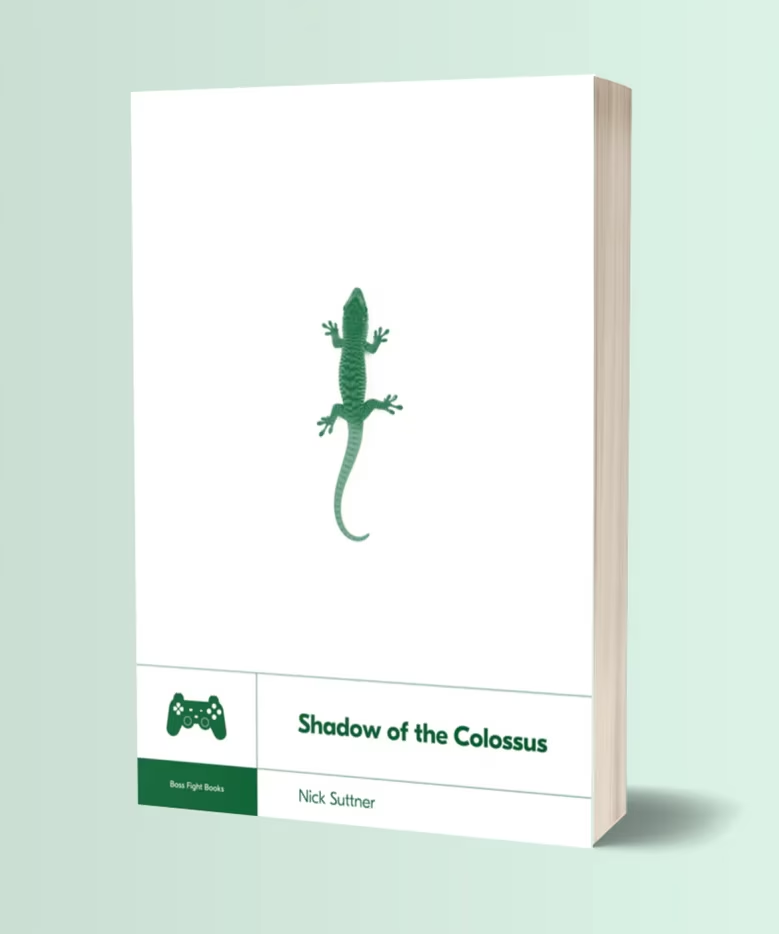
Book review Shadow of the Colossus (Boss Fight Books)
★★★☆☆
Decades ago, I used to work for a videogame magazine, but those days are long gone, and any videogame I play is a rare and intentional event.
Shadow Of The Colossus, the 2005 title directed by Fumito Ueda, felt so important to get to know that I had to borrow a PlayStation in order to play it, instead of waiting for a conversion (which never came; the game remains a PlayStation exclusive even today).
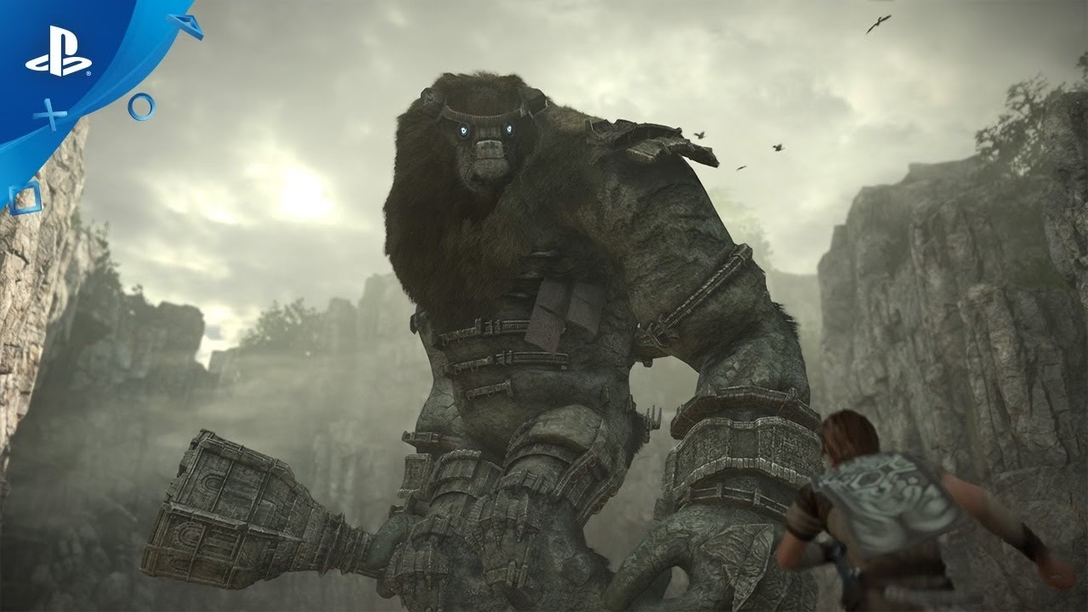
If you are not familiar with the title, I’m going to say little – the approach taken by the game, as well – and just point you toward the trailer for its remastered edition:
Boss Fight Books has been publishing books about videogames since the early 2010s, and “Shadow of the Colossus” by Nick Suttner is a book number 10 out of 40+.
The rather small and short volume is divided into chapters talking about each level of the game, one by one. But don’t let this discourage you – after all, recaps can be a literary art form. Here, every chapter goes on a side quest to talk about a larger component of the game or its backstory.
Having said that, the writing didn’t fully connect with me. Some of the tangents do not flow well, and the author’s choice to put himself in the book yields mixed results. In good moments, it’s wonderful to see someone’s passion for the game, but at times we’re also subjected to tenuous anecdotes about, for example, author’s beard, or his walks in San Francisco.
But the game! The game is definitely worth knowing more. It’s widely considered a masterpiece, a testament to choosing only a few things and doing them exceedingly well, a celebration of minimalism and deliberation, with so much – from world design to nuances of haptics – intently focused on creating the right ambiance to tell a story.
This might be strange to say, but I have this belief the rules of world building and care about atmosphere apply even to boring enterprise apps with stock UI elements. You’re still creating a universe and its set of principles, figuring out how to walk the user through it all via certain narrative beats, and – ideally! – thinking about all the small design decisions that will contribute – ideally! – to a consistent overarching tone.
The book occasionally peeks under the curtain to reveal design choices and details that could be inspiring to more than game designers: the control scheme, the fluid camera movement, intentional repetition of themes just to have them subverted, or the fascinating concept of “futile interactivity” (giving the player control even if the outcome is predetermined). What is interesting in particular are paths not taken: the initial idea of 48 monsters pared down to 16, or the multiplayer roots abandoned to focus on a linear, single-player experience.
(In a particularly brilliant decision, the creators took some of the unfinished levels and still put them in the game… as ruins.)
Is it a perfect book? No. But I’m glad I read it, and that writing about videogames in this form still exists – for a while, this was called “new games journalism” – and one way or another, it’s good to get closer to this strange beast of an AAA game with an indie game’s soul.