“Cryptic mode was born from a hard constraint.”
Software engineer Ajitem Sahasrabuddhe recently wrote a 6-post series called “Iron Core” about airline ticketing infrastructure. The entire series is probably too software engineer-y for us, but the third part has some interesting info about a particular 1960s user interface called “cryptic mode”:
Cryptic mode was born from a hard constraint: teletype terminals in the 1960s billed by the character transmitted. Every keystroke cost money. A command that took 50 characters instead of 10 cost five times as much. Commands were compressed to the absolute minimum.
The result is a domain-specific language whose syntax was shaped entirely by economics. AN for Availability Next. SS for Sell Segment. NM for Name. ER for End and Retrieve. No vowels wasted. No words spelled out.
Apparently the official name is “native mode,” but it gained its nickname because… well, see for yourself.
Asking the system for “Availability for Next flight” for February 8, from Nagpur to Delhi, is just 13 characters:
AN08FEBNAGDEL
And the system responds in an equally mysterious way:
** AMADEUS AVAILABILITY - AN ** NAG DEL SU 08FEB 0000

1 AI 416 Z9 C9 D9 Y9 B9 NAG DEL 0840 1030 32A 0

2 AI 416 M9 H9 K9 Q9 T9 NAG DEL 0840 1030 32A 0

3 6E 5317 S9 T9 W9 V9 Q9 NAG DEL 0840 0755 32A 0
With time these commands became wrapped inside more approachable interfaces and GUIs. But they exist under the hood and…
Many experienced travel agents still use it today alongside, and sometimes instead of, web-based agent interfaces such as Amadeus Selling Platform Connect. For a trained operator working a booking-heavy workflow, it is faster than the equivalent graphical interface for the same sequence of operations.
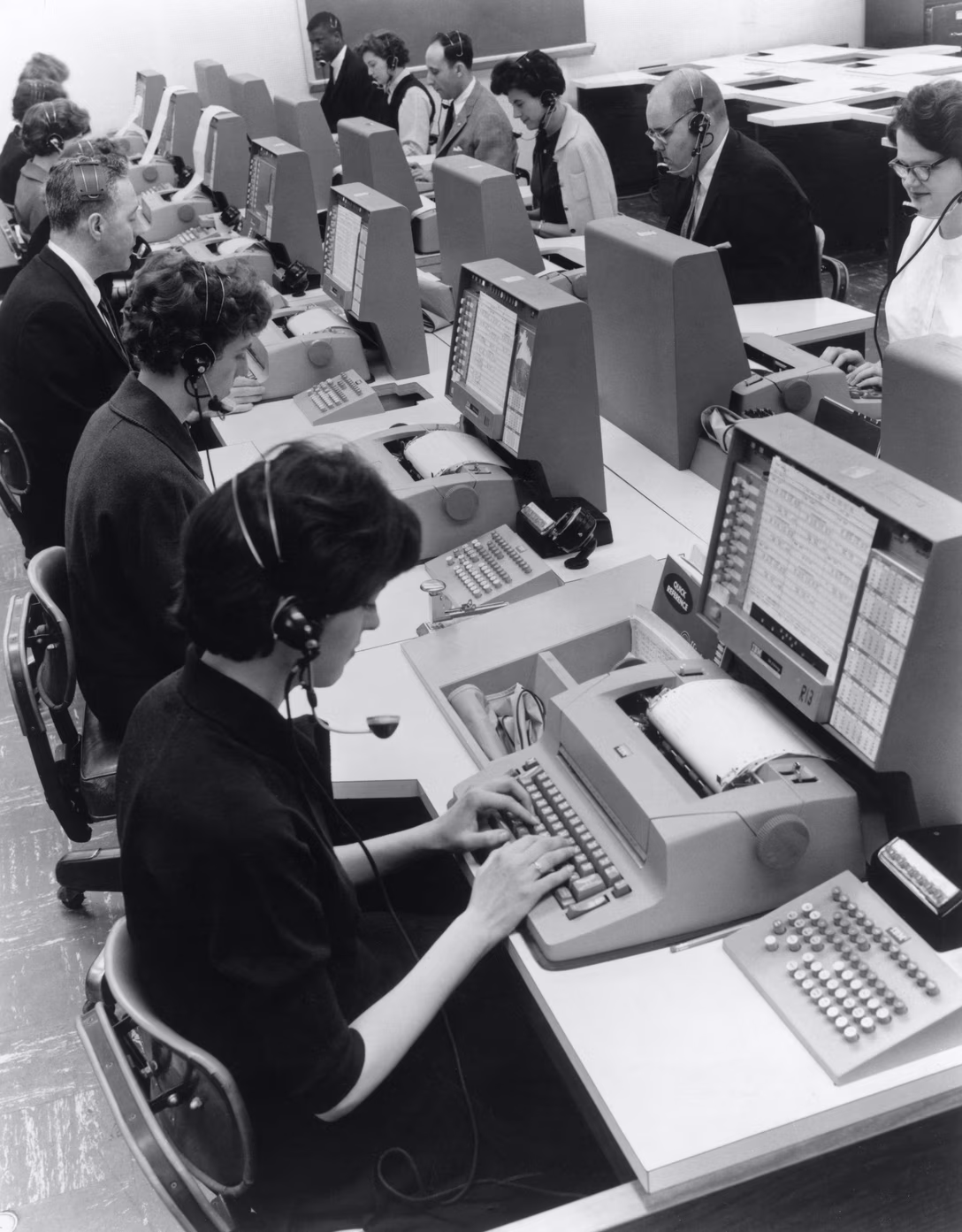
Except today, you get to choose. At the beginning, when “online” didn’t imply internet, and registration computers looked like this, you didn’t have a choice: this was the language you had to fluently write and read.
It makes Unix commands, also intentionally short/cryptic, look like Microsoft Bob.