Mailbag: The curious case of the disappearing Polish S
Even before the “remaster,” my essay about the Polish S bug was routinely discovered by Hacker News and other places, so I thought I would take a look at all the commentary over the years and summarize.
First, pragmatically, these are the lessons for any keyboard shortcut designer:
- On Windows, AltGr (Right Alt) and Ctrl+Alt shortcuts are one and the same, and Right Alt and alphabetic keys are used for some languages to output regular accented letters. You should not prioritize Ctrl+Alt shortcuts anywhere your users write text.
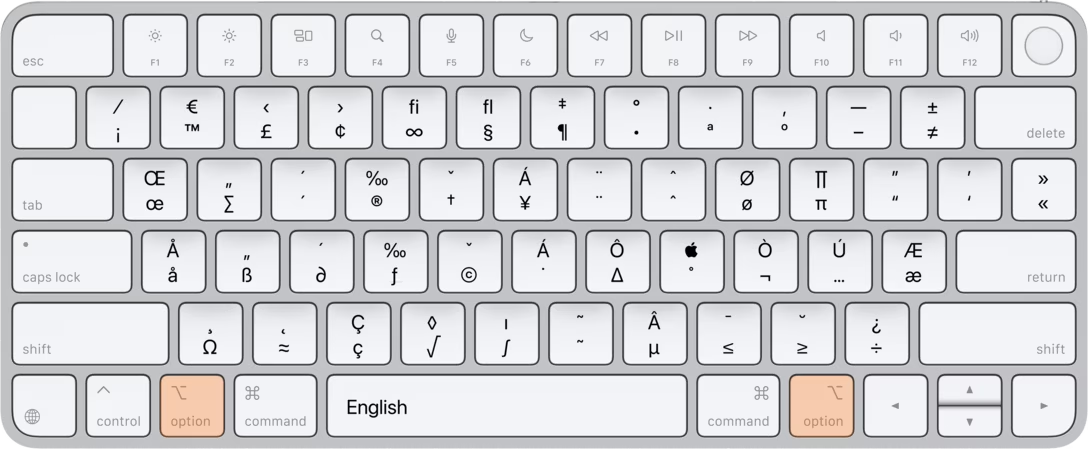
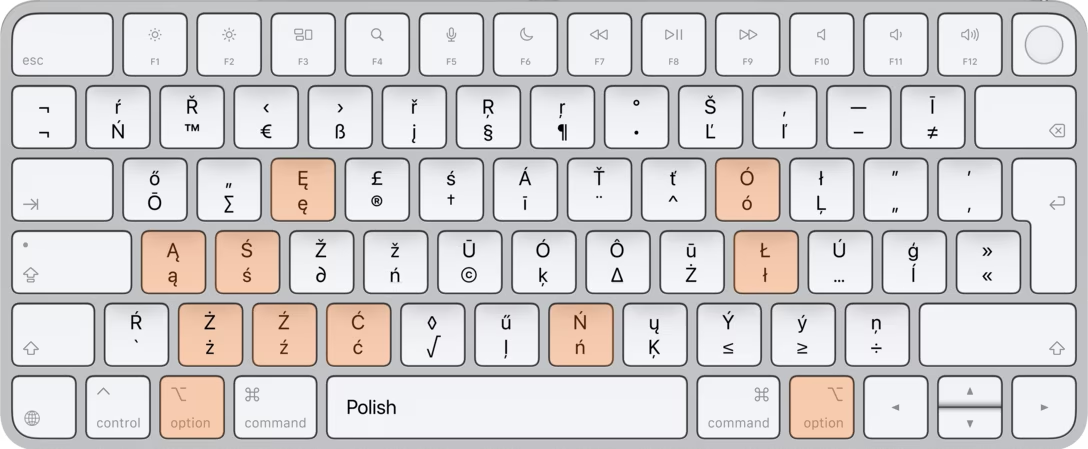
- On a Mac, ⌥ and most keys generate characters. They do so even on English layout for extra typographical flair, but particularly in other languages, regular accented letters might hide there. Note that these are not just letter keys, but also digits and other keys. You should not prioritize ⌥ shortcuts anywhere your users write text.
I couldn’t find a good image, so I made these two as an example. First is Mac’s American keyboard with ⌥ held. Second is Polish keyboard with ⌥ held, with Polish letters highlighted:
Jumping to the promised comments, I liked this story:
Outlook has a shortcut Alt+S to send the current e-mail. In Polish “Hello” is “Cześć”. When you acidentally have non-Polish locale enabled and write “Cześć” in Outlook - you send “Cze” as your whole e-mail.
“Cze” is a very informal greeting, sth like “Yo”. There has been thousands of such e-mails in Polish companies sent to people who really shouldn’t be greeted with “Yo.” :)
Here’s a little summary of other similar bugs. I verified some of them:
- “Oh, that explains why I accidentally triggered Claude with Alt+Space, despite it being configured as Ctrl+Alt+Space.” Link
- “Noticed similar issues with official Australian VISA / immigration pages. You can’t simply fill some forms with your email address using Finnish keyboard. Why? Because they block usage of AltGr button on their page. They also prevent using clipboard blocking copy paste option for that sign. User has to be smart enough to switch to US keyboard and then enter @ sign and then switch back. So this is nothing new, but it’s absolutely rude from part of the site designers to vandalize basic functionality like that. Normally @ is produced by AltGr+2.” Link
- “In a similar fashion, you cannot type the capital letter Ł in Notion. You type the letter with ⇧⌥L on the Polish keyboard on a Mac. Notion uses the ⇧⌥L keyboard combo for its own purposes.” Link
- “Medium learnt its lesson in 2015. Google still hasn’t and you cannot type Ś in Sheets, at least not on MacOS.” Link
- “Meanwhile, in 2026 I suddenly cannot type capital Ś in Edge on Mac. I feel like I moved back in time 25 years or so.” Link
- “I wonder if it is a similar reason why currently on MS Teams I can’t type the letter ń.” Link
- “It’s just like the new Copilot 365. Every time I try to type Ć, Copilot pops up. I have to close the app constantly.” Link
- “I had a similar issue when ASUS’s bloatware background service decided to bind something to both Alt+S and Alt+A globally. I have to keep it disabled or else I won’t be able to type ą, Ą, ś and Ś without using Caps Lock to work around the issue.” Link
- “In an Nvidia overlay there is a shortcut Alt+Z. It’s pretty annoying because it triggers on both left and right Alt, so polish users cannot type letter ż without opening the overlay or rebinding it. Nvidia pls fix.” Link
- “The very same bug used to be present in early Windows mobile GPU drivers - with global hotkeys making it impossible to enter Ł (with Intel GMA 950) and Ć (with ATI Catalyst). Being a Polish geek, I used to earn lots of free dinners from frustrated friends who were forced to copy-paste those letters on their brand new laptops. Funny how the same bug recurs in different types of software due to an obscure locale-dependent edge case - and it’s much less known than, for example, the Turkish dotted/dotless I.” Link
- “Installing KeePass used to silently disable ”ą” key (AltGr+A hotkey). KeePass broke system of every Polish user immediately after being installed.” Link
I’m sharing this for awareness. I believe many other languages/writing systems also have this problem; the examples are lopsided toward Polish only because my original example was about Polish.
Lastly, I found this an interesting anecdote:
In Portugal we had a similar workaround in the early days of computers not supporting our alphabet properly. Like in Polish there are plenty of words that without diacritics get another completely unrelated meaning, e.g. caça vs caca, which you didn’t want the interpretation to be left to the receiver.
So tricks got invented, like adding additional letters for the missing diacritics, é becomes eh, è becomes he or eh as in the former case, the example above would be cac,a and so on. However it was still quite flexible, not everyone uses the same extension set.
I wouldn’t be surprised if every single language outside of English developed some sort of a way to cope and adjust to limitations of originally American-oriented computers. In my book, I wrote about Japanese and Turkish, and there is another book – The Chinese Typewriter – that spends a lot of time talking about this very issue for China.
If this subject is particularly interesting to you, venture out into the Hacker News waters to see more commentary: 2015, 2021, 2024, 2026.