“Duh, I thought everyone already knew this.”
One of the leaders in the popular game Civilization was Gandhi:
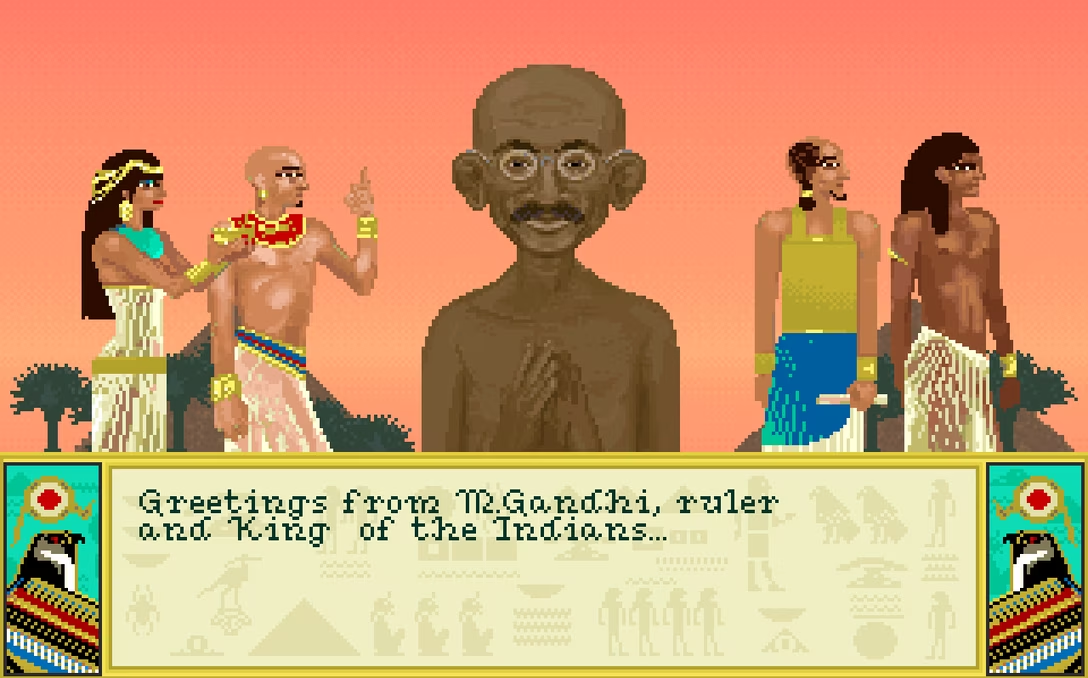
But there was a problem with how Gandhi was set up, as described in the book Sid Meier’s Memoir! by the game’s creator:
[…] all of the leaders were given a score from 1 to 12 across a number of variables, and Gandhi’s military aggressiveness was placed at 1, as would be expected. A different piece of code, however, called for an automatic two-point drop in military aggressiveness whenever a country adopted democracy, which would theoretically have put Gandhi at a score of negative 1. But since negative numbers were impossible in this type of calculation, an overflow error caused the value to wrap around to the top of the number list, giving him a score of 255. Thus, the moment India became democratic, Gandhi would turn into a vicious warmonger and begin nuking everyone in range.
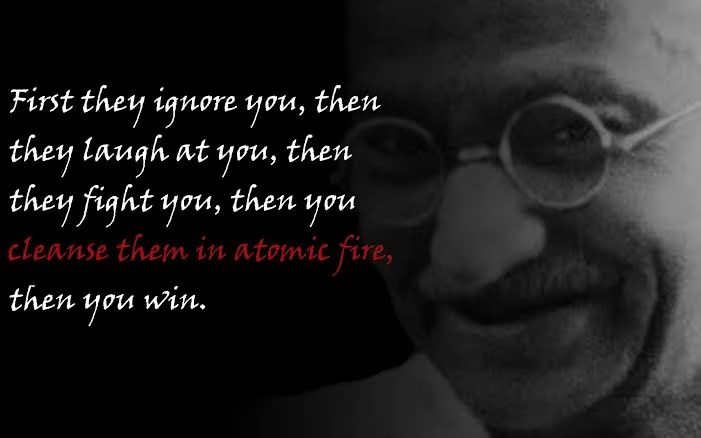
A revision was quickly sent out, but players were so charmed by the hilarious juxtaposition that it became a running joke that has been thoroughly enjoyed and built upon by fans ever since. Images of Gandhi with captions like, “First they ignore you, then they laugh at you, then they fight you, then you cleanse them in atomic fire,” and “A nuke for a nuke will make the whole world bow down to me” have been shared far and wide. Other memes needed no words at all, like the photoshopped picture of Gandhi riding the falling bomb at the end of Dr. Strangelove.
It’s a fun story and the 1 to 255 transition feels plausible, especially in the world still remembering Y2K. Here’s the kicker, though:
But it’s not the countless callbacks and references that make the nuclear Gandhi story so funny to me. It’s the fact that none of it is true. The overflow error never happened at all.
It is true that Gandhi would—eventually—use nukes when India was at war, just like any civilization in the game, and at the time this did strike a lot of players as odd. The real Abraham Lincoln probably wouldn’t have nuked anyone either, but the idea was that every leader draws a line in the sand somewhere. It’s also true that Gandhi would frequently threaten the player, because one of his primary traits was to avoid war, and deterrence through mutually assured destruction was an effective way to go about that. Since all leaders used the same basic diplomacy script, Gandhi’s reminder that “Our words are backed with nuclear weapons!” was identical to Napoleon’s or anyone else’s, and perhaps came off as a bit of a non sequitur from the humble ascetic. […]
But at no point did a democratic score change, or any value approaching 255, come into it. That kind of bug comes from something called unsigned characters, which are not the default in the C programming language, and not something I used for the leader traits. Brian Reynolds wrote Civ II in C++, and he didn’t use them, either. We received no complaints about a Gandhi bug when either game came out, nor did we send out any revisions for one. Gandhi’s military aggressiveness score remained at 1 throughout the game.
Meier seems to be annoyed by this, and does thorough investigative work in the book:
Where, then, did it come from?
The first reference appeared in July 2012—two years after Jon’s game, and more than two decades after the original game’s release—when a user named “Tunafish” added the supposed trivia to the website TVTropes.org, which can be edited by anyone. It sat, untouched except for cosmetic changes, until November of that year, when a watered-down version of the same story was added by an anonymous user to Wikia, […]
Six weeks later, the spread began. First, two well-established users of a gaming forum repeated the story, with one of them citing the Wikia page after someone asked for a source. A few posts trickled out to other small forums over the next few days, again meeting only a single expression of skepticism, which was this time refuted with the TVTropes link.
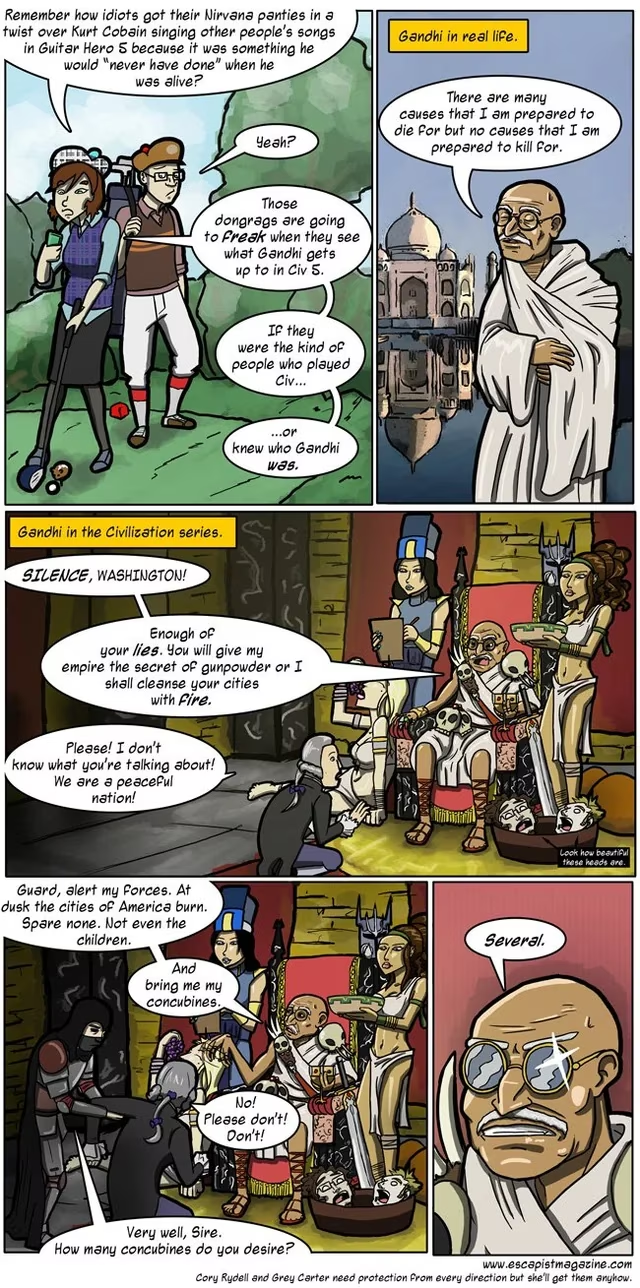
Things percolated gently for the next year and a half […]. The big break came in October 2014, when a comic called “Real Life Gandhi vs. Civilization Gandhi” was re-posted on Reddit. The comic itself was several years old, and only generically highlighted the humor of putting Gandhi’s finger on the button at all, but in the comments that followed, half a dozen users chimed in to share the story they’d heard about the overflow error. With that many in agreement, it became truth.
Then, it was Kotaku, and Geek Dot Com, and eventually a popular website Know Your Meme that listed the bug as “confirmed.” Then:
Six months after that, it was presented as a real-world example of an overflow error in the curriculum of a computer science class at Harvard University. Today, the story is still being revived on major news sites and message boards on a regular basis […] and almost always triggers at least a few replies of, “Duh, I thought everyone already knew this.”
We talked recently about how makers of a mellow Japanese game were a bit perplexed by a bug in the game becoming an urban legend. We also covered some games that leaned into their bugs in their sequels.
In the case of Civilization, the creators eventually leaned into… the bug that wasn’t. The lead designer of Civilization V, Jon Shafer, in the words of one Wikipedia editor “made Gandhi a nuclear weapon enthusiast.” The game was set up so that Gandhi’s internal “Build Nuke” and “Use Nuke” would always be maxxed out at 10 out of 10. As you can imagine, this did not help in squashing the myth. I’ll finish by quoting Wikipedia’s “Legacy” section:
Despite its non-existence, “Nuclear Gandhi” is one of the most recognizable bugs in the history of video games. It has spawned a large number of Internet memes, and it has been used as an example of integer underflow in computer science courses at Harvard University, among others.
The identity of “Tunafish” remains a mystery.