For love (of typography)
It’s Halloween Week on Unsung, where we’re sharing scary, spooky, and creepy stories. This is a another true one.
I’m the kind of a strange person who presses ⌥[ and ⇧⌥[ and ⌥] to get to the smart quotes directly from the keyboard. Yeah, I’m doing it right now. Yeah, it’s awkward. Yeah, I know that these days a lot of software automatically introduces curly quotes for you – I even wrote some of that software myself at Medium – but I started doing this in the early 2000s, and you know how motor memory goes: Once it’s all there, it feels so natural there’s no reason to change anything.
When the iPhone first came around, it was a similar story. The automatic curly quote routines weren’t there yet, but if you pressed and held the straight quote key, you’d see a little popover, and could move your finger to the proper typographical quote:
Yeah, it was awkward. Yeah, I was doing it anyway – slowly at first and then, as my fingers got used to it, more eagerly.
At around that time, I began seeing someone. We went on a date, and started texting each other, but from early on, there was something off about our conversations that I couldn’t quite put a finger on. There were chats that ended strangely, and the reactions to my texts that weren’t what I expected.
I initially chalked it up to getting to know each other, to the awkwardness of texting, and all that. But then, in real life, things were strange, too – the few dates we went on trended downward, and after two weeks or so and a short fight, it was over.
Something didn’t sit right with me, though. One of the accusations in that last fight was “you don’t respond to my texts,” which didn’t feel right to me – and, as a matter of fact, it was me who felt that way.
The accusation stung. The evening after a breakup, I looked at our message history more carefully, trying to make sense of it all. It was, I imagine, both slightly pathetic and perfectly human in a way post break-up activities are.
But that night it paid off, as I found out something that I did not expect at all. I don’t know how to build up to it, so I will just say it:
The other person has never received any of my texts where I used smart quotes or en dashes.
I’m not too eager to revisit those old messages that still exist somewhere in the depths of my phone archives, but you can imagine it looking something like this:
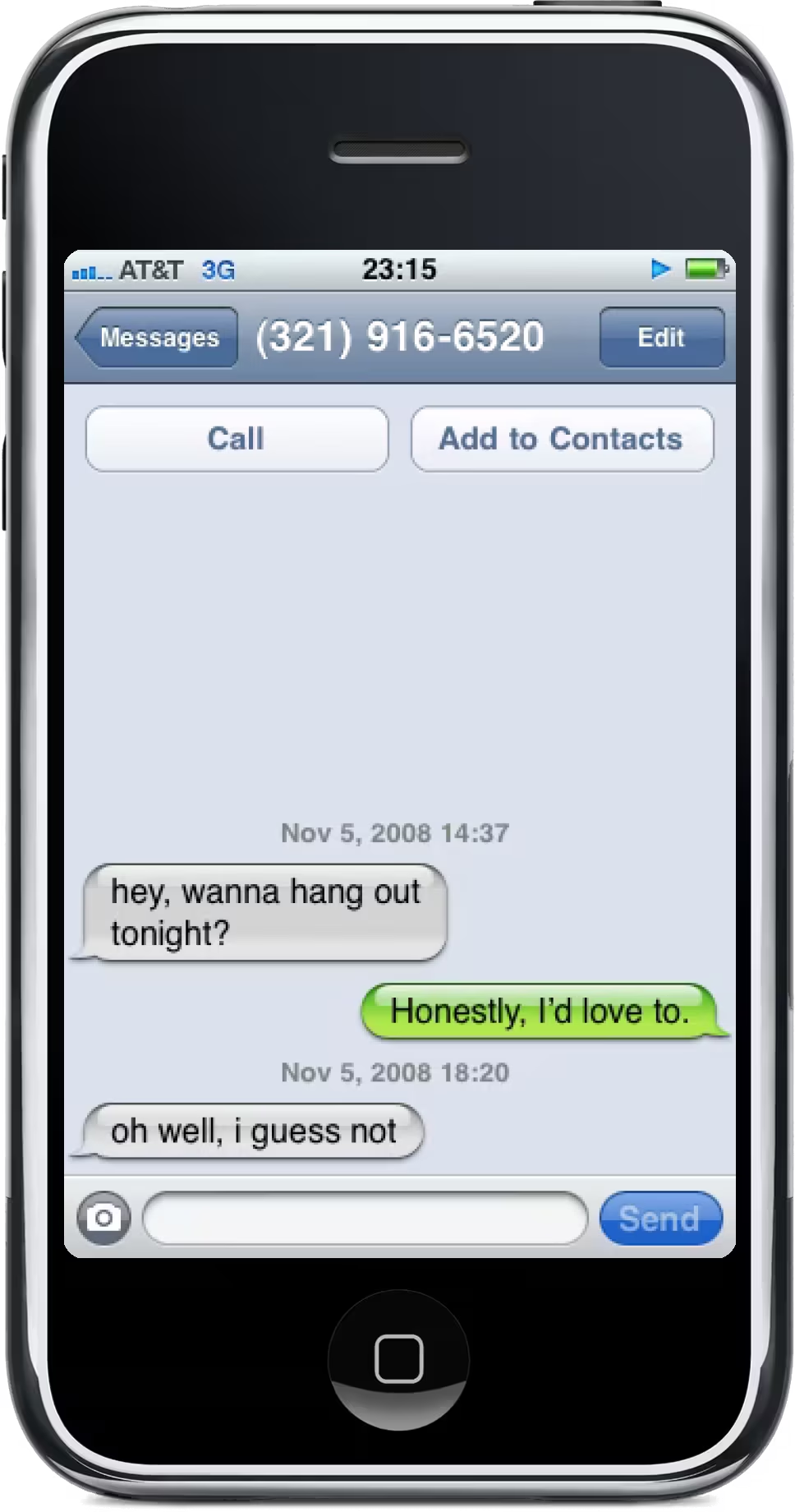
In hindsight, it made some sense. I was on the first iPhone, she was using an early Android device. In the famously finicky SMS flow, something ended up just quietly rejecting any of my texts with non-ASCII characters, without any warning to either party. Any time I tried to do the right typographical thing, I unknowingly sabotaged the burgeoning relationship.
Imagine me, on a sad night some time in the late 2000s, scrolling up and down iMessage, at the moment I pieced it all together. I must have stood up from the couch. It really did feel like the “I’m seeing dead people” cinematic reveal, in more ways than one.
I never reached out – our compatibility challenges felt bigger anyway – but imagine trying to explain any of this to anyone under these circumstances. In the end, there was only room for one kind of love, and it was my love for smart quotes.