Noise as information and information as noise
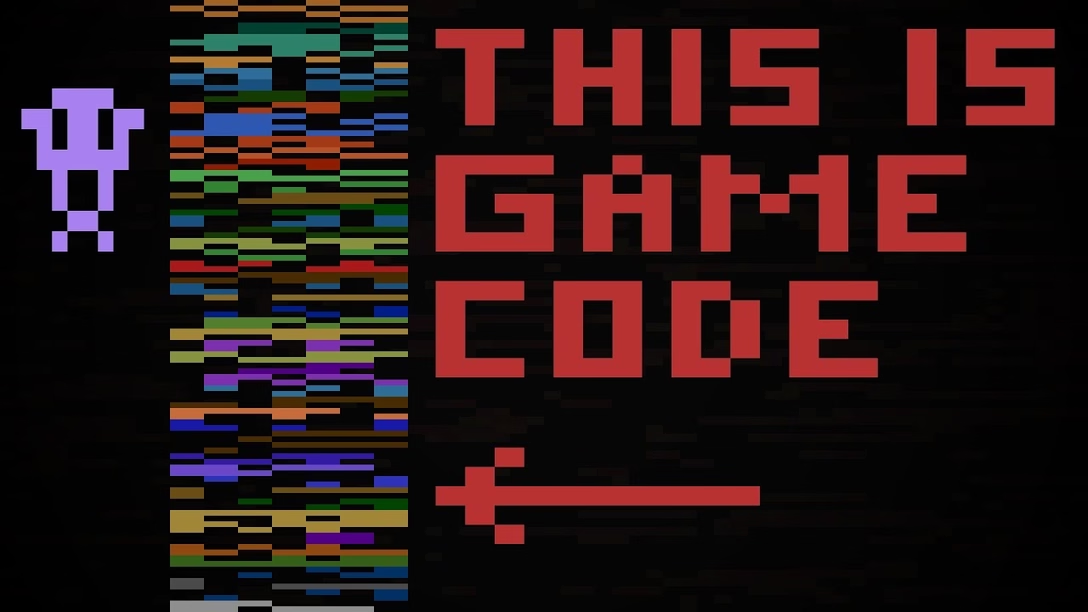
In 1982, the videogame Yars’ Revenge for the Atari 2600 needed to show a “neutral zone” in the middle of the screen. The console was so primitive – an entire great book was written about this – that it didn’t have any video memory. Any cheap effect would do, even random noise… but something as simple as generating noise was also too much for the underpowered system. So the creator of the game decided to do something that in any other situation would mean at the very least trouble, if not a downright security disaster. He crossed the wires and output on screen… the game’s own source code:
The source code looked noisy enough, and the problem was solved. (Somewhat recently, Retro Game Mechanics Explained analyzed it carefully in this YouTube video, to make sure it’s not just a myth.)
A similar approach was used in a Nintendo GameCube game Metroid Prime, at a moment when the protagonist’s visor needed to appear disrupted. It was two decades later, but the team still bounced off of hardware limitations, this time around memory:
The GameCube only has 24MB of RAM, so every texture has to be carefully considered. If we used a low resolution texture (64x64) to save memory the “static” would be blurry and not crisp. One engineer on the team came up with a great idea: what if we just use the memory holding the Metroid Prime code itself! We quickly tried it out and it looked amazing. When you see Samus’s visor affected by electrical “noise” in game, you’re actually seeing the bits and bytes of the Metroid Prime software code itself being rendered on the screen. Turns out machine code is sufficiently random to work great as a static noise texture!
This is how it looked:
A few years later, in 2008, people working on Xbox 360 were testing a new interface for their entire console. It was called NXE – New Xbox Experience – and in the bottom-right corner it showed delightful ripples:
…or, not just delightful. While NXE was tested internally, the ripples actually encoded the serial number of the console, to prevent leaks. Apparently, it was built specifically so that Microsoft only needed just two images to find out the entire serial number.
A less surreptitious version of this idea exists today – for example, setting up a new Apple Watch shows a pretty pattern…
…that also happens to encode enough information to identify the specific one watch. It really appears to be nothing more than an obfuscated QR Code, and “boy, have they patented it.”
I know concealing a message inside another message is called steganography. I don’t think all of these fall under that umbrella, and I don’t even know all the above can be called “hacks.” I just thought they were interesting examples of information masquerading as noise, and noise pretending to be information.