“If you aim for the king, you better not show up eight years late.”
Something different for today: a one-hour episode of a podcast A Life Well Wasted from 2025. (I can’t link to it directly, but it’s the most recent episode, called “Game Over.”)
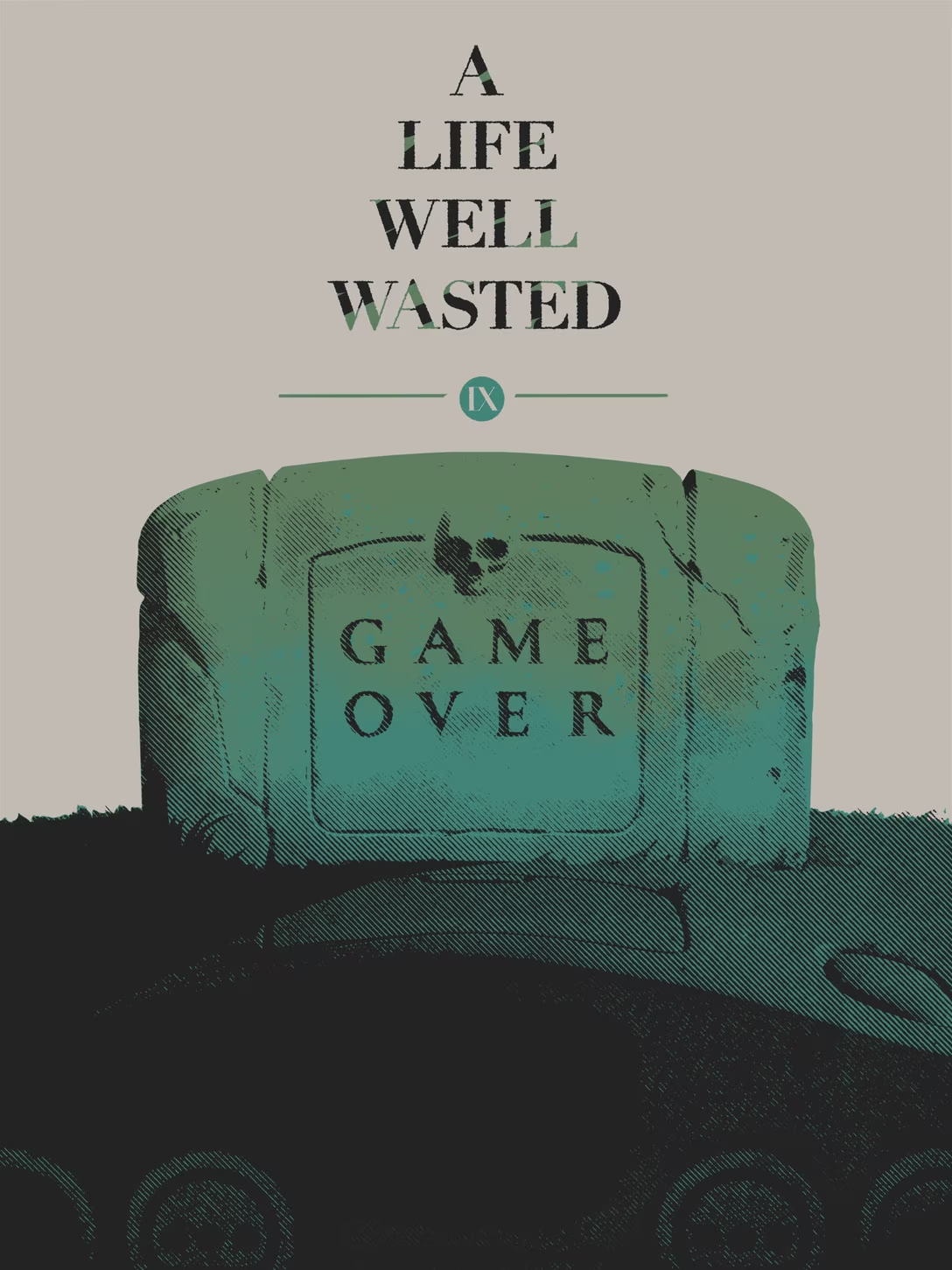
It’s a human story whose beats might be familiar to some of you: a long software project that ultimately failed despite the enormous effort. And it did so in an industry – high-budget videogames – where failures might feel particularly brutal: the projects take multiple years but the defeat can be swift, the servers get shut down and the game instantly evaporates, and instead of employees being reallocated to other games, the studio gets disbanded and people let go.
There are some nice moments in the podcast’s interviews with about a dozen people, hearing about personal pride and responsibility, working together with others, and a certain camaraderie not just with other people, but with their software that develops:
I think the best part about it was being able to play with my coworkers and then cutting loose, and being silly, and really enjoying what we made together, as a unit. That experience alone made it worth it.
There are also questions about the management’s role in all of this – this part we might never get to know fully – and the worry about game preservation.
This is not mentioned in the podcast, but it seems widely understood the story is about Concord, a AAA live-service game that is rumored to have cost a staggering $400 million dollars and taken 8 years to develop, only to be shut down mere 12 days after its launch in the late 2024. (AAA means a blockbuster with highest budgets seen by the industry, and live service means a game like Fortnite, which is expected to make money over time from add-ons and upgrades.)
Learning about Concord’s macro view adds a lot of color to the boots-on-the-ground podcast above, but one has to be careful exploring it; the online discourse about the game felt similar to the 2016 reboot of the movie Ghostbusters where sure, the product might have been subpar, but also a lot of commenters seemed eager to arrive to the conversation carrying truckloads of bad faith, gatekeeping, and misogyny.
Some good articles? Keza MacDonald in the Guardian has a nice summary of the whole situation:
This is a brutal sequence of events. Sony bought the makers of Concord, Firewalk Studios, in 2023. Concord had been in development for eight years, and it was an expensive game, with bespoke cinematics and a long-term plan that would have cost $100m or more to develop. In its two weeks on the market, it sold fewer than 25,000 copies, according to estimates. This is a shocker, even compared with the year’s other bad news for developers and studios.
MacDonald also adds:
Speaking personally, I do not want a game that takes years to play. I want one with something to say, an experience to impart, and one that eventually ends. A game whose artistry comes before its business model.
This is partly a matter of taste. Self-evidently, there is an enormous market for live-service multiplayer games; it’s just that most of those people are already playing one. I highly doubt that there are untapped millions of players desperate for a hero shooter or battle royale game who just haven’t found the right one yet. It’s time that publishers try something new instead.
An article by Matt Kim at IGN adds to this notion:
With so many games now taking close to a decade from the beginning of development to release, we’re starting to see the financial and creative consequences of an overlong development cycle. Spend too much time in development and ideas that were once novel are no longer in vogue. Furthermore, the time and money spent over those years has to be recouped somehow, which leads to decisions like the $40 cost of entry for Concord when many of its peers are free to play.
The cost of coming late to the party means you must bring something new to the table. Unfortunately, Concord is neither particularly innovative nor content-heavy. That said, it does have a level of polish at launch that was often absent from its hero shooter peers when they were first released. Indeed, Concord’s weekly animation story drops are fully motion-capture, and Firewalk’s time spent on crafting its lore has helped secure Concord an episode of this winter’s video game animation anthology series, Secret Level.
But well-established hero shooters like EA’s Apex Legends launched almost bare bones and still managed to make a splash thanks to its intriguing central concept which combined hero loadouts with a battle royale match format. Valve’s Deadlock doesn’t even have finalized assets or art but has still caused a huge burst of excitement among the PC community, thanks to the way it changes up the classic 6v6 hero formula with its heavy lane-and-minions MOBA [Multiplayer Online Battle Arena—ed.] mechanics. By contrast Concord appeared with an all-too-familiar offering and, frankly, the time spent on finessing its presentation – the graphics, motion capture, performance, and so on – likely lead to a later release date which in turn meant it lost valuable time establishing itself among its peers. If it had been released four or five years ago, when the PS5 first came out, maybe its launch would have been an entirely different story.
I think this is important to quote on this blog that often talks about “finessing” and implicitly – or sometimes explicitly – about the value of taking time to get the details right. We can’t forget that there are such things as overdesigning and overproducing, and that ultimately there is no way to polish your way out of something that lacks a soul.